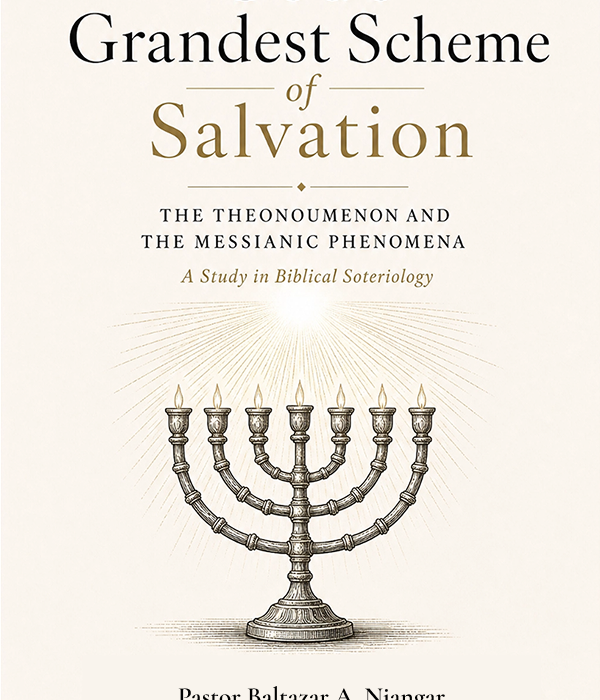

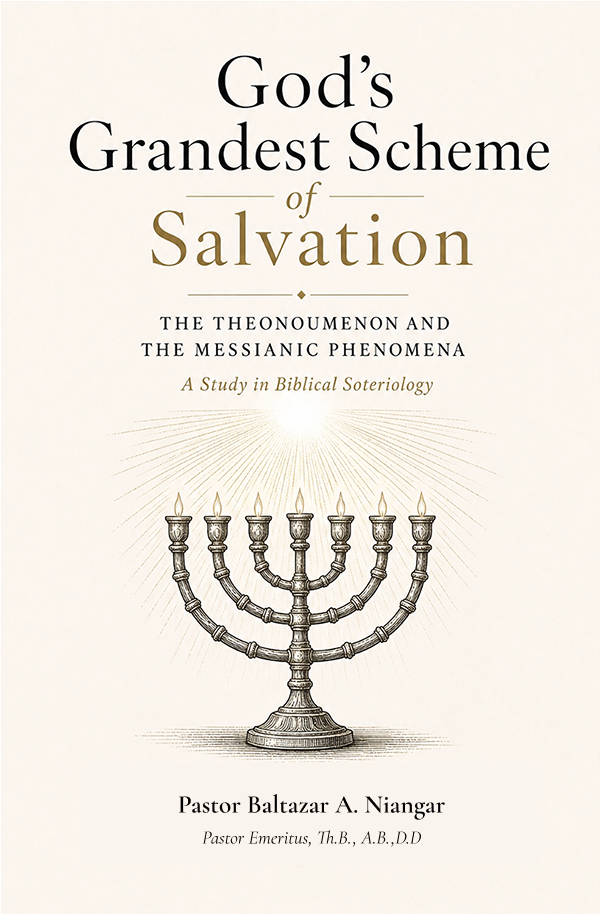
The Theonoumenon and the Messianic Phenomena — A Study in Biblical Soteriology
Ds. Baltazar A. Niangar · 6th volume in the Niangar Theological Library
Salvation isn’t a rescue plan improvised after Adam’s fall — it’s God’s single, eternal, Christ-centered “scheme” that Dr. Niangar unpacks through two of his own coined terms: the Theonoumenon (God’s eternal mind on salvation) and the Messianic Phenomena (how that eternal purpose unfolds in history through Christ).
- Theonoumenon (Gk. theos + nous + menon) — God’s eternal, simultaneous, non-sequential decree of salvation. Niangar pictures it as a circle, not a line: “Declaring the end from the beginning” (Isa. 46:10) means God doesn’t plan the way we do, working from a start toward a hoped-for end — He holds the whole picture at once, like a photograph rather than a line-by-line drawing.
- Messianic Phenomena (Heb. masshach + Gk. phenos/menon) — the progressive, historical unfolding of that eternal purpose through the person and work of Jesus Christ, from election to consummation.
Together they answer: what did God eternally purpose, and how did it actually play out in history?
Chapter-by-chapter breakdown
Preface / Introduction — “The Grandest Scheme” Salvation is God’s eternal purpose, not a contingency plan. Two conceptual tools (Theonoumenon + Messianic Phenomena) give the reader “altitude” to see the whole picture rather than getting lost in a single controversy or doctrine.
Ch. 1 — Biblical Salvation: Definition and Hermeneutics Defines core vocabulary: salvation (comprehensive restoration, not just rescue from hell), sin (iniquity, transgression, rebellion — missing the mark), redemption/atonement (the kaphar covering, foreshadowed when God clothed Adam and Eve in animal skins), and “scheme” (Gk. schema — a purposive outline containing its own substance). Draws a key distinction between two Greek words for “buy” in 2 Peter 2:1 and Acts 20:28 to explain the classic Reformed view of the atonement as unlimited in sufficiency, limited in effectual application. Sets the hermeneutical key: Christ-centered reading of all Scripture (leaning on Oscar Cullmann).
Ch. 2 — The Fourfold Image of God in Mankind The imago Dei is soteriological, not just anthropological — you can’t understand what salvation restores without understanding what sin damaged. Four dimensions:
- Mental — wisdom/knowledge (modeled in Christ’s growth in wisdom, Luke 2:52)
- Moral — holiness/righteousness (restored through sanctification)
- Modal — the fullness of personhood reflecting God’s own richness beyond human gender categories
- Managerial — dominion exercised as service, not domination (Phil. 2:5–7)
Ch. 3 — The Theonoumenon: God’s Eternal Mind on Salvation Lays out twelve points on the “circle” of God’s eternal decree — Election, Creation, Fall, Messianic Prophecy, Incarnation, Crucifixion, Gospel Preaching, Justification, Sanctification, Transformation, Glorification, and the Father’s Glory — and argues every point circles back to Christ as the center. “To know Christ is to know the Theonoumenon.”
Ch. 4 — Salvation and the Christian World-Life View Builds a set of concentric circles: an outer ring of four “Divinity” doctrines (Decree, Creation, Providence, Theodicy), a controlling center of four “Biblicality” commitments (Revelation, the Biblical God, the Biblical Christ, the Biblical Gospel), and four surrounding “quadrants” of human life (Intellectuality, Physicality, Sociability, Spirituality) that the gospel touches and transforms.
Ch. 5 — The High Priestly Prayer and Christian Unity Works through John 17 and Ephesians 4:3–13’s threefold unity (practical, positional, eschatological) to land on a signature pastoral position: “non-denominational in spirit, denominational in fellowship.” Charitable toward believers across traditions, while still committed to a local, evangelical, disciplined congregation.
Ch. 6 — The Scheme of God: Theonoumenon and Messianic Phenomena Restates the historical unfolding as eleven dimensions (a slightly different count/emphasis than Ch. 3’s twelve — worth noting for internal consistency), and walks through the Reformed ordo salutis (election → effectual calling → regeneration → faith/repentance → justification → adoption → sanctification → perseverance → glorification). Key pastoral point: salvation is proclaimed as a divine commission, not offered as a human invitation to decide.
Ch. 7 — The Seven Churches and the Course of Redemption A tour through Revelation 2–3’s seven churches as both real historical congregations and representative “spiritual profiles” recurring across church history — Ephesus (orthodoxy without love), Smyrna (faithful under persecution), Pergamum (compromised by false teaching), Thyatira (tolerated heresy), Sardis (reputation vs. reality), Philadelphia (faithful and fruitful), Laodicea (lukewarm). Strong blog potential on its own — very shareable, self-diagnostic content.
Ch. 8 — The Christian World-and-Life View Summarized Ties the three key concepts together (Theonoumenon = God’s-eye view, Messianic Phenomena = historical view, Personal Experience = the believer’s own encounter), unpacks three Greek words for “church” (kuriakon, ekklesia, koinonia), and lands on the phrase “simply Christians.”
Conclusion — Great Peace: Yahweh Shalom Closes not with more argument but with worship — the “great peace” of Psalm 119:165, tied to the Heidelberg Catechism’s opening Q&A (“What is your only comfort in life and in death?”).
Soli Deo gloria.
About the Author
The Reforming Christian Church
Read the Full Study →
God’s Grandest Scheme of Salvation with reflection questions for personal or group study and a full Scripture index.
Support the Ministry Through Gumroad
Support the ministry with an amount of your choice.

Our All in Christ is the teaching ministry of Pastor Baltazar A. Niangar, sharing biblical resources to help believers grow in God’s Word and the grace of Christ. View All Manuscripts
READ THE FULL STUDY
The Reforming Christian Church
Read the Full Study →
God’s Grandest Scheme of Salvation with reflection questions for personal or group study and a full Scripture index.
Support the Ministry Through Gumroad
Support the ministry with an amount of your choice.