
“Bearing with one another and, if one has a complaint against another, forgiving each other; as the Lord has forgiven you, so you also must forgive.” — Colossians 3:13
I have sat with people who were deeply wronged and felt that forgiveness asked too much. I have also sat with people who wanted to be forgiven without turning from what they had done. Both are looking for the same thing, and neither finds it until they see what forgiveness actually is. It is not a feeling we work up, and it is not a verdict we hand down when we are ready. It is a gift that begins with God, and it asks something of us because of what He has already given.
In this study, drawn from lectures I gave over the years, I follow that gift in three movements: how it is founded, how it shapes our behaviour, and how it makes us like Christ.
Founded: Forgiveness Grounded in the Triune God
Christian forgiveness does not begin with us. The Father justifies, so that those who believe have “peace with God” (Rom. 5:1). The Son redeems, having obtained His Church “with his own blood” (Acts 20:28). The Spirit applies that work inside us, and this is why a forgiveness we cannot manage in our own strength is still possible. When I cannot forgive, I am not meant to try harder. I am meant to return to the cross.
Fundamental: Forgiveness as Moral Imperative
Those who have been forgiven much are bound to forgive much (Luke 7:47). Paul’s teaching in Romans 12 shows what that looks like in three habits. Remember our own sinfulness (Rom. 12:16). Forgive those who wrong us, as the Lord has forgiven us. And refuse to let bitterness settle in.
Forgiving is not the same as excusing. Scripture still calls for honest confrontation (Matt. 18:15), but its goal is restoration, not revenge. Anger at a real wrong is not itself the sin. What Paul warns against is anger kept past its season, because it gives “opportunity to the devil” (Eph. 4:27).
Fully Christlike: Forgiveness as Conformity to Christ
The deepest level of forgiveness is not a rule but a Person. To forgive as Christ forgave is to love as He loved (Matt. 22:37–40), to be holy as He is holy (1 Pet. 1:16), and to be free from the power of offence.
“Great peace have those who love your law; nothing can make them stumble.” — Psalm 119:165
Jesus was misunderstood, betrayed, and abandoned, and He never lost His peace, because His security was in His Father (John 8:29). That is the freedom He offers us. It is not forgiveness as a performance. It is a settled peace that no offence can undo.
Where This Leaves Us
Three questions stay with me. Are we really founded on Christ? Are we really living in Christlikeness? And are we, by God’s grace, innocent of offence toward our neighbour? These questions do not condemn us. They point us back to the One who was “pierced for our transgressions” (Isa. 53:5) and who prayed, “Father, forgive them” (Luke 23:34). His forgiveness makes ours possible.
Soli Deo gloria.
About the Author

Our All in Christ is the teaching ministry of Pastor Baltazar A. Niangar, sharing biblical resources to help believers grow in God’s Word and the grace of Christ. View All Manuscripts
READ THE FULL STUDY
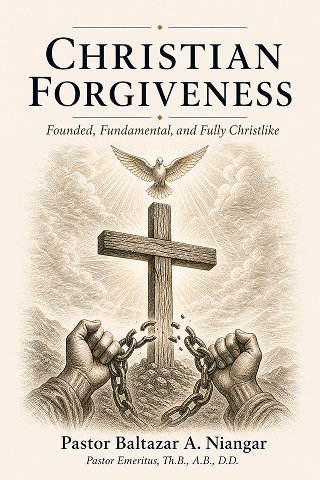
Christian Forgiveness
Read the Full Study →
Christian Forgiveness adds three reflection questions for each chapter, personal questions and challenges, a glossary, and a Scripture index.
Support the Ministry Through Gumroad
Support the ministry with an amount of your choice.