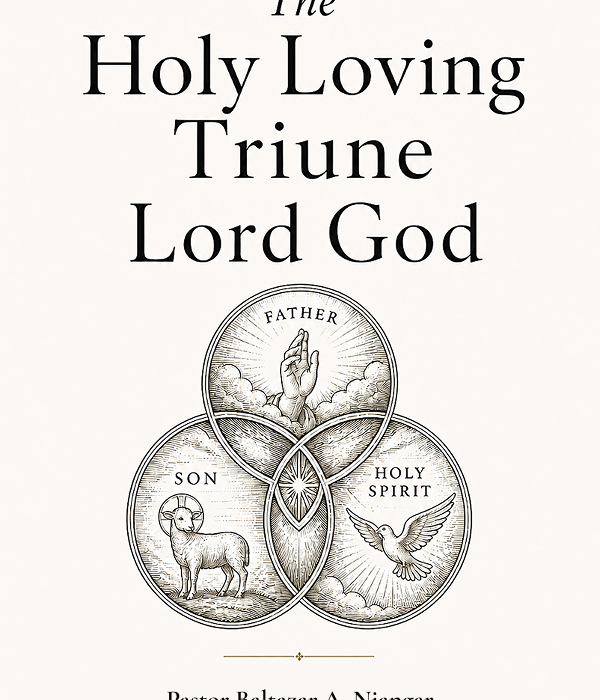

This volume argues that the doctrine of God isn’t one theological topic among many — it’s the one subject every other subject is secretly about. Dr. Niangar walks through six attributes/relations of the Triune God (holiness, integrity, uniqueness/infinity, love, fatherhood, lordship) and lands, deliberately, not on a tidy conclusion but on worship: the mystery of God remains, and that’s the point.
Chapter-by-chapter breakdown
Preface / Introduction — “The Subject of All Subjects” Every discipline — philosophy, science, ethics, aesthetics — only finds its proper orientation in relation to God. Theism, theology proper, theodicy, and cosmology all converge on this one doctrine. The invitation of the book isn’t to master the knowledge of God but to enjoy it — Niangar’s own image is swimming in an ocean whose floor is always deeper than the dive.
Ch. 1 — The Holiness of God Holiness isn’t one attribute alongside the others — it’s the attribute that governs all the others (a holy love, a holy wisdom, a holy justice). Explains why Isaiah’s seraphim cry “Holy, holy, holy” rather than any other triple repetition. Moves from contemplation to command: “Be holy, for I am holy” (Lev. 19:2; 1 Pet. 1:16), which can only be obeyed through the Spirit’s sanctifying work.
Ch. 2 — The Integrity of God Unpacks God’s wholeness (divine simplicity — not composed of parts), immutability (He does not change, with strong pastoral payoff: the God who saved His people in the past is the same God saving them now), eternal peace/shalom, His love as essential to His Being rather than just His behavior (a key distinction the book returns to in Ch. 4), and His truth (He doesn’t just tell the truth — He is Truth, per John 14:6).
Ch. 3 — The Uniqueness and Infinity of God Two sides of one coin: uniqueness (God is in a category of His own — Being, behavior, as Ultimate Cause, as Infinite, as Impartial) and infinity (transcendence, eternity, omnipresence, omnipotence, omniscience). Strong devotional material here, especially Psalm 139:7–8 on omnipresence and Exodus 3:14’s “I AM WHO I AM” on eternity.
Ch. 4 — The Love of God Builds directly on Ch. 2’s distinction: God’s love is essential to His Being, not merely His behavior — meaning it’s as eternal and inexhaustible as God Himself. Distinguishes incommunicable love (private, shared only among Father, Son, and Spirit) from communicable love (extended outward to creation as goodness, grace, and mercy). Also covers God’s Name, Fatherhood, sovereignty, and benevolence, and — notably — frames even God’s wrath as an expression of holy love, not a contradiction of it.
Ch. 5 — The Fatherhood of the Triune God Distinguishes three kinds of divine Fatherhood: Ontological (eternal, within the Trinity itself — the Father eternally begets the Son), creative (Father of all creation), and redemptive (Father of the adopted, believing elect). Warns that conflating these leads either to universalism or to a Trinity reduced to mere “functional roles.” Also covers the eternal Trinitarian fellowship (in holiness, love, and truth) as the archetype for all genuine human community, and traces covenant from the eternal Trinitarian relationship through the Covenant of Grace to the Covenant of the Blood (the New Covenant in Christ’s blood, Luke 22:20).
Ch. 6 — The Lordship of the Triune God The culminating chapter. Lordship is expressed in two works held together: rule and redemption — “a God who rules without redeeming is a tyrant; a God who redeems without ruling is a sentimentalist.” Revisits the Reformed unlimited/limited atonement distinction from God’s Grandest Scheme of Salvation(propitiation sufficient for all; applied savingly to the elect). Closes on the Unity of the Triune God — not bare numerical oneness but the unity of three co-equal, co-eternal Persons in one Being, will, love, and purpose — calling the reader to total worship: spirit, soul, heart, mind, strength, and body.
Conclusion — YAHWEH SHALOM: The Mystery Remains Deliberately doesn’t try to resolve the mystery of God. Uses the image of a “lamp in the daylight” — genuinely illuminating, but illuminating something infinitely larger than the lamp itself (1 Cor. 13:12, “we see in a mirror dimly”). Ends where the Preface said it would: in worship, not mastery.
Soli Deo gloria.
About the Author

Our All in Christ is the teaching ministry of Pastor Baltazar A. Niangar, sharing biblical resources to help believers grow in God’s Word and the grace of Christ. View All Manuscripts
READ THE FULL STUDY
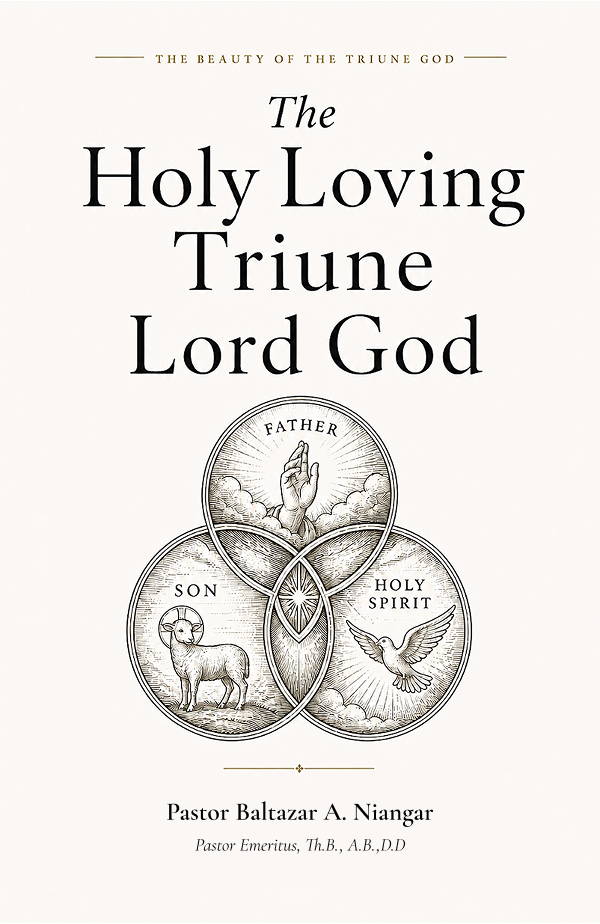
The Holy Triune Lord God
Read the Full Study →The Holy Triune Lord God with reflection questions, personal questions and challenges, a glossary, and a Scripture index.
Support the Ministry Through Gumroad
Support the ministry with an amount of your choice.