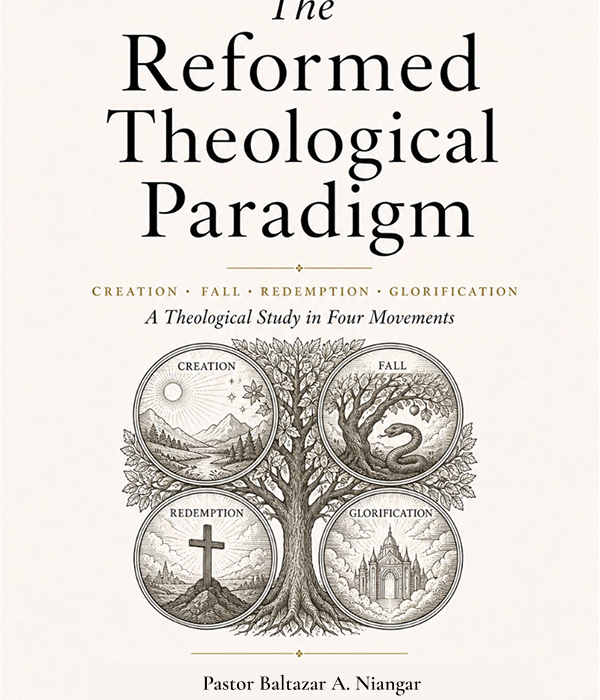

Creation · Fall · Redemption · Glorification — A Theological Study in Four Movements
Ds. Baltazar A. Niangar · a volume in the Niangar Theological Library, published by Crossway
Everybody interprets life through some paradigm — the only question is whether it’s a good one. Niangar argues the Reformed tradition’s four-movement story (Creation → Fall → Redemption → Glorification) isn’t an academic overlay on Scripture but the shape of the biblical narrative itself, and that losing sight of any one movement is exactly how doctrinal error and practical failure creep in.
Chapter-by-chapter breakdown
Foreword / Preface / Introduction — “The Need for a Reformed Paradigm” Everyone operates within some interpretive paradigm — the presuppositions and categories through which we read every event and doctrine. The question isn’t whether we have one, but whether it’s shaped by Scripture or assembled haphazardly from cultural fragments. Niangar’s thesis: theological error is almost never invention from nothing — it’s distortion, one true element of the story over-emphasized at the expense of the others. The four-movement paradigm exists precisely to guard against that imbalance.
PART ONE: Creation — The State of Divine Order
Ch. 1 — God the Creator: Process and Purpose Everything downstream (fall, redemption, glorification) is only intelligible against what God originally made and intended. Uses four Hebrew/Greek terms to describe the creative process: bara (fiat creation from nothing), asah (God the potter, shaping with craftsmanship), katartizo (God the architect, framing and fitting), and yatsar (God the designer, fashioning with intimate personal care — the word used for forming Adam from dust). Together these describe a creation that is powerful, skillful, wise, and intimate all at once.
Ch. 2 — The Perfection and Permanence of the Created Order Draws out implications: creation grounds human dignity (the image of God can’t be forfeited by sin, disability, or any human authority), grounds a positive Christian engagement with science/art/culture, and — crucially for the paradigm — sets the standard against which the fall’s damage will be measured. “To understand how deep the fall goes, we must first understand how good the creation was.”
PART TWO: Fall — Sin and Its Cosmic Consequences
Ch. 3 — The Origin and Nature of Sin Traces sin back before Genesis 3 to the “primordial sin” — Satan’s self-exaltation (Isa. 14:12–15; Ezek. 28:12–18), a fivefold cascade of “I will” that is the essence of pride: the creature’s refusal to accept its creaturely limits. Distinguishes discontent (refusing one’s lot) from discord (active rebellion), then moves to the human fall in Genesis 3, grounding total human solidarity in Adam via Romans 5:12. Sin is defined via 1 John 3:4 (“sin is lawlessness”) and 1 John 2:16’s threefold distortion of desire (flesh, eyes, pride of possessions).
Ch. 4 — The Pervasive Reach of the Fall Explains total depravity carefully (not “as evil as possible,” but “every dimension affected”). Extends the fall’s consequences beyond humanity to creation itself — Romans 8:18–23’s “groaning” creation, tied provocatively to the Second Law of Thermodynamics as a physical echo of the fall. Death is framed as an intruder into creation, not a natural feature of it — the “last enemy” to be destroyed at the resurrection (1 Cor. 15:26).
PART THREE: Redemption — Salvation by Christ
Ch. 5 — Spiritual Regeneration Christ’s redemptive work addresses every dimension of the fall’s damage. Regeneration is the Spirit’s sovereign work of bringing life where there was only death (Eph. 2:1–5) — not moral self-improvement but new creation (2 Cor. 5:17). Romans 8:11 is used to striking effect: the same Spirit who raised Jesus now indwells believers as a permanent life-force, guaranteeing both present transformation and future bodily resurrection.
Ch. 6 — Sacrificial Redemption and Societal Renewal Where regeneration addresses the internal/spiritual fall, this chapter addresses the legal fall — guilt before a holy God. Covers appeasement/acquittal (God’s justice satisfied, not relaxed, in Christ’s atoning death) and acceptance (believers aren’t merely acquitted but adopted as co-heirs — the imputation of Christ’s righteousness). Extends to personal and societal renewal: repentance (Ezek. 18:30) and faith (Eph. 2:8–9) as the twin instruments by which redemption is received — with redemption’s reach explicitly framed as more than private/spiritual.
PART FOUR: Glorification — Sanctification and Consummation
Ch. 7 — Genuine Reconciliation and Genetic Reformation Holds together present sanctification and future glorification as one continuous work God has committed to finish (Phil. 1:6). The deliberately provocative phrase “genetic reformation” captures a transformation that goes to the root of the person, not a surface behavioral fix — a resurrection of the dead, not the improvement of the sick (Eph. 2:1; Col. 3:1), held together with 2 Cor. 4:16–18’s “outer self wasting away, inner self renewed day by day.”
Ch. 8 — The General Resurrection The destination of the whole biblical narrative: the bodily resurrection of all the dead (1 Cor. 15, John 5:28–29). Emphatic that this is bodily resurrection, not merely the soul’s immortality — the “refashioning” of the corruptible body (Phil. 3:20–21) into imperishable, glorified form. Paul’s own logic is foregrounded: “If the dead are not raised, not even Christ has been raised… your faith is futile” (1 Cor. 15:16–17).
Conclusion — Walking in the Paradigm Ties the whole study together as “a map for living,” not just an intellectual framework: it tells us where we came from, where we are, where we’re going, and therefore how to live now. Spells out precisely what’s lost when each movement is neglected — lose creation, lose human dignity and the goodness of matter; lose the fall, lose the seriousness of sin and gospel urgency; lose redemption, lose the anchor of hope; lose glorification, lose the eschatological horizon that keeps present-age investment in proportion.
Soli Deo gloria.
About the Author

Our All in Christ is the teaching ministry of Pastor Baltazar A. Niangar, sharing biblical resources to help believers grow in God’s Word and the grace of Christ. View All Manuscripts
READ THE FULL STUDY
The Reformed Theological Paradigm
Read the Full Study →
The Reformed Theological Paradigm and deepen your understanding of this important Christian teaching.
Support the Ministry Through Gumroad
Download digital copies while supporting the ministry with an amount of your choice.