
by Pastor Baltazar A. Niangar, Pastor Emeritus, Th.B., A.B., D.D.
“And he made from one man every nation of mankind to live on all the face of the earth, having determined allotted periods and the boundaries of their dwelling place, that they should seek God, and perhaps feel their way toward him and find him.” — Acts 17:26–27
Every one of us sees the world through a lens we did not choose. We received it from our family and our culture long before we could examine it, and we rarely notice it until we sit across the table from someone who sees things differently. What are we to make of that difference? Is every way of seeing equally true, or is one culture simply right and the rest wrong?
In this study I ask what Scripture says about the great traditions of human thought. I find that the Bible has more to say than either flattery or contempt.
Every Culture Is Searching
I begin with a simple fact. No culture on earth has ever been without religion. God “has put eternity into man’s heart” (Eccl. 3:11), and what can be known about Him “is plain to them” (Rom. 1:19). Sin has bent that awareness, but it has not erased it. Every tradition I describe is a long human search for God, and Paul says that the God who is sought “is actually not far from each one of us” (Acts 17:27).
The East: Mystical and Intuitive
Confucius, Lao Tsu, and Mencius taught the East to value harmony, reverence, and the wisdom that goes beyond words. I see in this an echo of the law written on the heart (Rom. 2:15), and in the mystery of the Tao an echo of the God whose ways are “inscrutable” (Rom. 11:33). But the Tao does not speak, and no sage can save himself. The Gospel says that the One who is beyond all comprehension has spoken to us by His Son (Heb. 1:1–2).
The West: Materialistic and Intellectual
From Athens to the Enlightenment, the West taught the world to analyze, to test, and to build. I give thanks for it, because the study of creation is the study of God’s handiwork (Ps. 111:2). The danger is to treat only the measurable as real, and to make the human mind its own judge. Paul on the Areopagus shows a better way. He honoured what the Athenians already knew, and then he proclaimed the God who raised Jesus from the dead (Acts 17:31).
The North and the South: Imperialistic and Social
The North has been strong in organizing the world around it, in government, law, and commerce. That is a gift (Rom. 13:1), and it becomes a sin when ordering turns into ruling over others (Mark 10:42–43). I say plainly that the nations that sent missionaries also sent soldiers, and the Church should say so too.
The South has been strong in community, hospitality, and contentment. The word ubuntu, “I am because we are,” points to something the Bible teaches about the body of Christ (1 Cor. 12:26). It goes wrong when the community bows before powers that are not God (Acts 14:15).
Where This Leaves Us
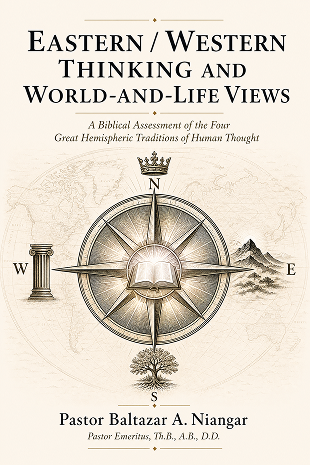
The Gospel does not destroy culture. It redeems it. It receives the gifts of every tradition, Eastern intuition, Western precision, Northern energy, and Southern community, and brings them under the Lordship of Christ. Each hemisphere has something to teach and something to learn. The Church is the one place where all of them are meant to sit at the same table, until the day when people from every tribe and language and people and nation worship the Lamb together (Rev. 5:9).
Soli Deo gloria.
About the Author

Our All in Christ is the teaching ministry of Pastor Baltazar A. Niangar, sharing biblical resources to help believers grow in God’s Word and the grace of Christ. View All Manuscripts
READ THE FULL STUDY
Eastern/Western Thinking and World-and-Life Views
Read the Full Study →
Discover What the Christian Church Should Be: A Call to Be Historic, Reformed, and Relevant.
Support the Ministry Through Gumroad
Support the ministry with an amount of your choice.