
by Pastor Baltazar A. Niangar, Pastor Emeritus, Th.B., A.B., D.D.
“Come now, let us reason together, says the LORD.” — Isaiah 1:18
Every person is already asking, “How do I know?” The student weighing a lecture, the parent reading the news, and the believer listening to a sermon are all deciding what counts as knowledge and whom to trust. Some Christians fear that thinking hard is the enemy of believing. I have found the opposite. The God who gave us the Scriptures also gave us minds, and He invites us to use them under His Word. In this study I ask three questions and answer each one from the Bible.
The Nature of Knowledge and Wisdom
What is genuine knowledge? I find three parts. The first is reality, which is twofold: the visible world, and the invisible world of God, the soul, and the moral order, all held together in Christ (Col. 1:17). The second is factuality, which means true history and true current events. The Christian faith stands on what actually happened, above all the resurrection (1 Cor. 15:3–4). The third is principles, the laws of logic and conscience that reflect a rational and holy God. These must be told apart from theories, opinions, myths, and hearsay, and we test them by the Word (1 Thess. 5:21).
The Origin of Knowledge and Wisdom
Where does knowledge come from? James names three sources: the wisdom from above, the wisdom that is earthly and demonic, and the wisdom of the fallen human mind (Jas. 3:15–17). I walk through the great Eastern and Western traditions, from Confucius to Plato and Aristotle, and on to pragmatism and postmodern thought. I honour what is true in them, and I show where each falls short without Christ. Christian thinking, from its Jewish roots to Paul’s great synthesis in Romans, begins where Anselm began: faith seeking understanding.
The Limit and Extent of Knowledge and Wisdom
How much can we know? Not everything, and yet enough. “The secret things belong to the LORD our God, but the things that are revealed belong to us and to our children forever” (Deut. 29:29). Our knowledge is bounded, for now we know in part (1 Cor. 13:12). It is also sufficient, because the Spirit has given us the mind of Christ (1 Cor. 2:16). The Christian does not need to know everything in order to know enough.
Thinking from Above
The Christian mind is not a retreat from the intellectual life of our age. It is a redeemed engagement with it. I invite you to receive the wisdom that comes from above, to be ready to give a reason for your hope (1 Pet. 3:15), and to speak the truth in love (Eph. 4:15). The One who calls us to reason is the One who made reason, and in His light we see light.
Soli Deo gloria.
About the Author

Our All in Christ is the teaching ministry of Pastor Baltazar A. Niangar, sharing biblical resources to help believers grow in God’s Word and the grace of Christ. View All Manuscripts
READ THE FULL STUDY
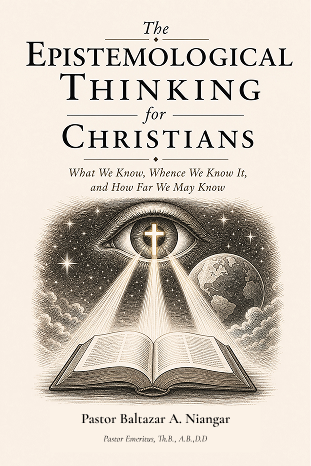
The Epistemological Thinking for Christians
Read the Full Study →
The Epistemological Thinking for Christians adds reflection questions for each chapter, personal questions and challenges, a glossary of key terms, and a Scripture Index.
Support the Ministry Through Gumroad
Support the ministry with an amount of your choice.