
by Ds. Baltazar A. Niangar, Pastor Emeritus, Th.B., A.B., D.D.
“He is the propitiation for our sins, and not for ours only but also for the sins of the whole world.” — 1 John 2:2
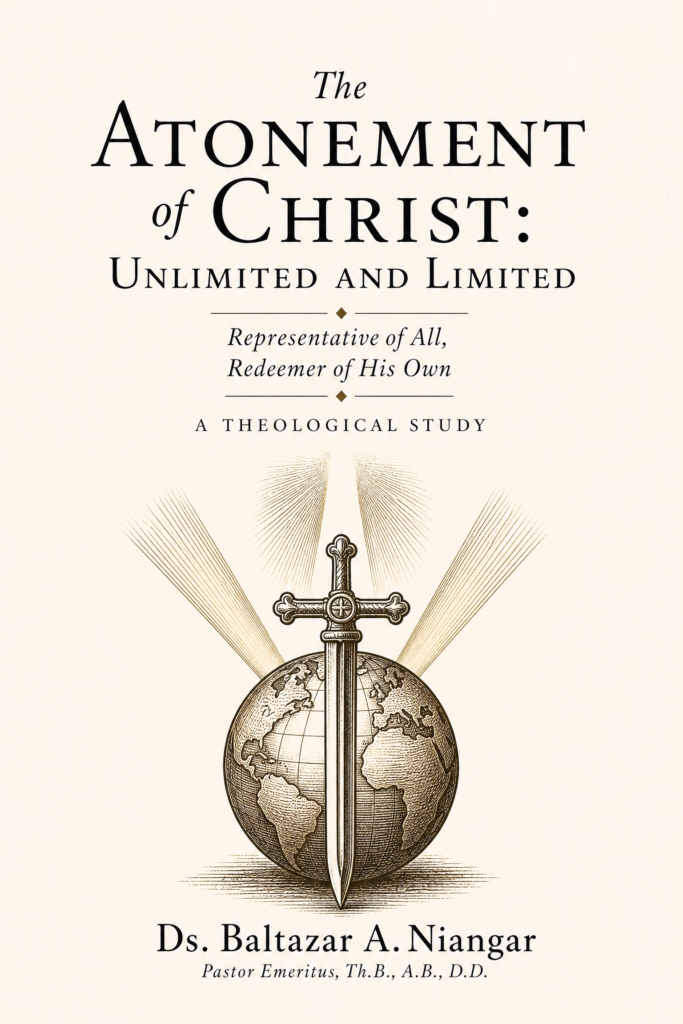
For centuries the Church has wrestled with a deceptively simple question: for whom did Christ die? The classical Calvinist answers, “for the elect alone.” The Arminian insists, “for every person without exception.” Both, I argue in my new book, The Atonement of Christ: Unlimited and Limited, have grasped something true while missing the fuller picture Scripture consistently presents.
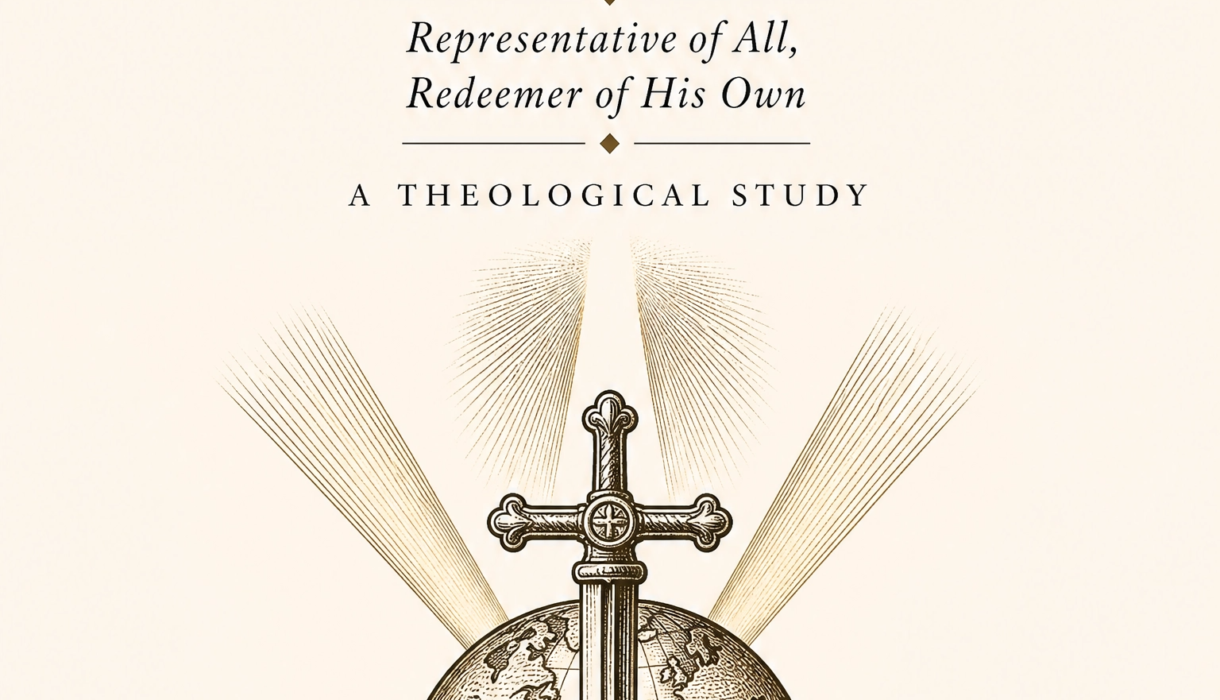
This is not an attempt to split the difference between Calvinism and Arminianism. It is a case, built chapter by chapter through the Trinity’s own work, that Christ died for all humanity in a real and meaningful sense — and for His elect in a particular, effectual, redemptive sense. These are not competing claims. They are two edges of the same sword.
The Father: Where Holy Love Meets Holy Justice
Before creation, before the first syllable of the cosmos broke the eternal silence, God was love — not merely loving, but love itself (1 John 4:8). It was from this inexhaustible love that the Atonement sprang. “For God so loved the world, that he gave his only Son” (John 3:16). The cross was never a reluctant concession wrung from an unwilling deity. It was the Father’s own initiative.
But love without holiness is sentiment, not the love of God. Isaiah’s vision of the seraphim crying “Holy, holy, holy” (Isa. 6:3) reminds us that God’s holiness is not an abstraction — it is the burning purity before which sin cannot simply be waved away. The cross is the place where the Father’s love and His holiness met, and neither was compromised. Both were fully satisfied. That is the mystery at the heart of the Atonement, and it’s why Scripture can say, in the same breath, that God’s love reaches every human soul (2 Cor. 5:19) and that His wrath against sin had to be justly dealt with (Rom. 1:18).
The Son: Representative of All, Redeemer of His Own
The eternal Son entered the created order as its rightful Representative — the Second and Last Adam (1 Cor. 15:45–49). Where Adam’s disobedience brought condemnation to all who stand in him, Christ’s obedience brings righteousness to all who stand in Him (Rom. 5; 1 Cor. 15). In this representative capacity, Christ bore the weight of universal human sin. The Lamb of God “takes away the sin of the world” (John 1:29) — and the world means the world.
But Christ is not only Representative; He is Redeemer. Redemption is slave-market language — to buy someone out of bondage. “You were bought with a price” (1 Cor. 6:20), and the church specifically is what “he obtained with his own blood” (Acts 20:28). This is the language of particular, effectual redemption: Christ did not merely make salvation possible for an indefinite multitude — He secured and guaranteed the salvation of His people. Representative for all; Redeemer of His elect. Not a contradiction, but the consistent testimony of Scripture about who Christ is and what He accomplished.
The Spirit: Sovereign Servant Who Makes It Real
An accomplished atonement is not, by itself, an applied salvation. Between Golgotha and the sinner’s actual new birth stands the work of the Holy Spirit. He regenerates the spiritually dead (John 3:3–8), illumines the darkened mind (1 Cor. 2:10–16), and produces the very repentance and faith by which a person lays hold of Christ. As Ezekiel prophesied: “I will give you a new heart… and cause you to walk in my statutes” (Ezek. 36:26–27). The causative verb is God’s, not ours.
This sovereign work is not a violation of human freedom — it is the restoration of it. The bondage sin produces is the deepest slavery there is; when the Spirit liberates the will, He does not coerce, He heals. Planned by the Father, accomplished by the Son, applied by the Spirit — the Atonement is the unified redemptive act of the Triune God, and no part of that work stands separate from the others.
Five Paired Senses: How the Cross Works on Two Levels at Once
The heart of the book is a framework I call the “five paired senses” of the Atonement — five ways the cross operates simultaneously on a wider, universal level and a narrower, particular one:
- Covering and Cleansing — the Old Testament sacrifices covered sin provisionally; Christ’s death cleanses it completely and finally for those in Him, while His forbearance covers the whole human race in the meantime.
- Appeasement and Acquittal — the wrath of God against all sin was exhausted at the cross; acquittal — justification — belongs to those who receive it by faith.
- Purchasing and Liberating — the purchase price was paid for all humanity, so no one can say it wasn’t paid for him; but actual liberation belongs to those who abide in Christ.
- Propitiation and Expiation — wrath was turned away for the sins of the whole world (1 John 2:2); the guilt itself is removed, as far as the east is from the west, for those who are in Christ.
- Forbearance and Forgiveness — God’s patience toward all humanity throughout history rests on the cross; full forgiveness belongs to those who repent.
Each pair carries a wider dimension, rooted in Christ’s representative work for all humanity, and a narrower dimension, rooted in His redemptive work for His elect. They are not the same reality wearing two labels — they are genuinely distinct operations of one atoning work.
Why It Matters for How We Preach the Gospel
This is not theology for its own sake. Because the cross has unlimited scope in Christ’s representative work, the evangelist can look any person in the eye and say: Christ died for you. There is no sin so great His blood cannot cover it, no heart so hardened His Spirit cannot break through. And because the cross has particular, effectual efficacy in Christ’s redemptive work, the believer can rest with complete confidence — salvation resting not on the shifting sands of personal perseverance but on the unchanging rock of a redemption planned by the Father, accomplished by the Son, and sealed by the Spirit.
That is the gospel the apostles preached and gladly died for. May it deepen your wonder at the cross, sharpen your understanding of the gospel, and stir your heart to proclaim it with greater clarity and confidence.
Soli Deo gloria.
About the Author

Our All in Christ is the teaching ministry of Pastor Baltazar A. Niangar, sharing biblical resources to help believers grow in God’s Word and the grace of Christ. View All Manuscripts
READ THE FULL STUDY
The Atonement of Christ: Unlimited and Limited
Read on Kindle or Order a Print Copy
Purchase individual titles through Amazon Kindle and enjoy them digitally or in print.
Support the Ministry Through Gumroad
Download digital copies while supporting the ministry with an amount of your choice.