The Thinking Process of the Christian Mind: Position, Practice, and Perspective
Posted in :

by Ds. Baltazar A. Niangar, Pastor Emeritus, Th.B., A.B., D.D.
“Do not be conformed to this world, but be transformed by the renewal of your mind, that by testing you may discern what is the will of God, what is good and acceptable and perfect.” — Romans 12:2
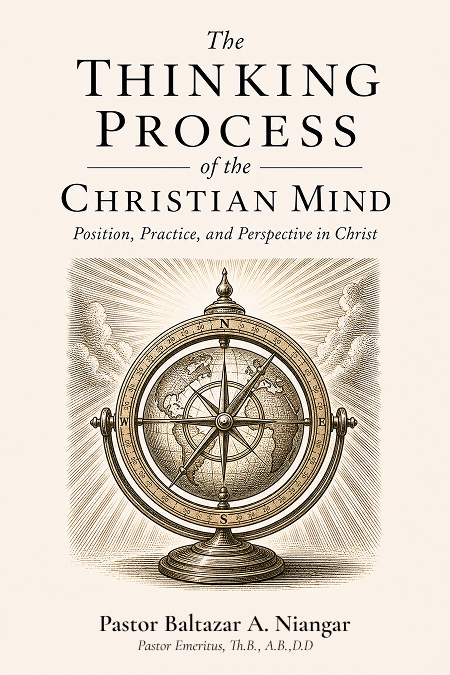
The Christian mind does not arrive at maturity the moment a person believes. It is a mind in motion — being renewed, being transformed, being conformed step by step into the image of Christ. That is the conviction at the heart of my new book, The Thinking Process of the Christian Mind: Position, Practice, and Perspective in Christ.
This is not a call to a Christianized version of secular intellectualism. It is an invitation to think God’s thoughts after Him, to live as His image-bearers in a broken world, and to anticipate the glory that is coming. Three markers, I argue, define this process — and they form the architecture of the whole book.
Position: The Foundation Nobody Can Shake
Before a Christian ever thinks or acts differently, something has already happened to them. Jesus says, “All that the Father gives me will come to me, and whoever comes to me I will never cast out” (John 6:37). The Christian did not choose God first — God chose the Christian. That is the deepest ground of assurance any believer has.
This position is secured through regeneration, the new birth worked by the Spirit, and experienced personally through conversion — genuine repentance from sin and genuine faith in Christ. The regenerate mind is not simply a mind furnished with new information. It is a mind given new sight, capable of perceiving the invisible realities of the Kingdom of God and reordering all of life around them.
Position in Christ, though, is not a static trophy to be displayed. It is the living foundation from which everything else — practice and perspective — grows.
Practice: What Position Looks Like on a Tuesday
A renewed position that never produces a renewed life is a contradiction. “If anyone would come after me, let him deny himself and take up his cross daily and follow me” (Luke 9:23). Self-denial is the first, non-negotiable mark of discipleship — not an asceticism that despises creation, but the daily surrender of self-lordship to the lordship of Christ.
The second mark is devotion to Christ and His Word: “Let the word of Christ dwell in you richly, teaching and admonishing one another in all wisdom, singing psalms and hymns and spiritual songs, with thankfulness in your hearts to God” (Colossians 3:16). This devotion is never merely private study. It is relational and communal — formed in the gathered church, where the Word is preached, sung, practiced, and embodied together. A disciple who withdraws from that community cuts herself off from one of the primary means God uses to renew the mind.
Perspective: Seeing All of Life as God Sees It
The maturing Christian mind eventually develops what I call a cosmoscope — a comprehensive way of seeing the whole of life, drawn from the Greek kosmos (world) and skopeo (to view). Romans 12:1–2 is its charter: the transformed mind discerns the will of God in every domain of life, not just the “religious” ones.
This cosmoscope rests on three convictions. First, the whole world is created by God — not an accident, not a self-generated system, but the work of a personal, sovereign Creator (Genesis 1:1; John 1:3; Hebrews 1:3). Second, our whole life is for His glory: “Whether you eat or drink, or whatever you do, do all to the glory of God” (1 Corinthians 10:31) — there is no square inch of human life, professional or domestic, intellectual or recreational, that stands outside that call. Third, our whole life is under God’s righteous governance. Joseph’s testimony is the paradigm: “As for you, you meant evil against me, but God meant it for good” (Genesis 50:20). The Christian cosmoscope does not offer naive optimism in the face of suffering, injustice, or confusion — it offers the hard-won confidence of those who have wrestled with God and found Him faithful.
Three Questions, One Direction
The real and true Christian, I argue in the book’s conclusion, has three defining characteristics: a position in Christ, a practical life imitating Christ, and a perspective different from this world’s system. None of these is an achievement to be earned — they are gifts to be received and then worked out, “for it is God who works in you, both to will and to work for his good pleasure” (Philippians 2:12–13).
So the questions worth sitting with are not abstract. Are we really Christians — not only in what we say we believe, but in the transformed shape of our minds and lives? Do we shine as spiritual lightbearers and serve as spiritual salt in a darkened and tasteless world? Are we thinking differently from what this world thinks?
The Christian mind is being renewed. It is not yet complete. It still wrestles with conformity to this world, still sees in part, still struggles to take every thought captive to obey Christ. But the direction is set and the power has been given: “We all, with unveiled face, beholding the glory of the Lord, are being transformed into the same image from one degree of glory to another. For this comes from the Lord who is the Spirit” (2 Corinthians 3:18).
Soli Deo gloria.
About the Author

Our All in Christ is the teaching ministry of Pastor Baltazar A. Niangar, sharing biblical resources to help believers grow in God’s Word and the grace of Christ. View All Manuscripts
READ THE FULL STUDY
The Thinking Process of the Christian Mind: Position, Practice, and Perspective
Read the Full Study →
The Thinking Process of the Christian Mind: Position, Practice, and Perspective in much greater depth, with reflection questions for personal or group study and a full Scripture index.
Support the Ministry Through Gumroad
Download digital copies while supporting the ministry with an amount of your choice.